]
In a disturbing revelation, an investigative report has exposed a worrying trend in the hiring process for various positions within the Uttar Pradesh (UP) Legislative Assembly. It appears that despite claims of merit-based recruitment, a significant portion of the jobs in the UP House are going to individuals with strong political connections or powerful familial ties rather than those who pass the competitive exams.
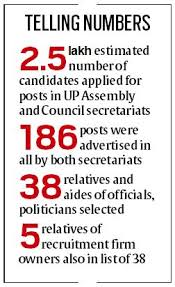
According to sources, up to a fifth of the recent appointments within the UP Legislative Assembly have been given to the relatives of influential figures, including the children of Principal Secretaries and staff members associated with high-ranking political officials. This revelation has sparked a public outcry, with allegations of nepotism and favoritism in the state’s recruitment process.
The Examination Process: A Farce or Genuine?
The UP Legislative Assembly, one of the most crucial organs of governance in the state, has long maintained that its recruitment procedures are transparent and based on merit. However, the recent wave of appointments following a series of competitive exams has raised serious questions about the integrity of the process.
Candidates from across the state had been given the opportunity to compete for various positions within the UP House, including clerks, assistants, and other administrative roles. The exams, organized by the Assembly’s recruitment board, were initially hailed as a much-needed reform aimed at curbing corruption and ensuring that only qualified individuals were hired for key positions. However, the appointments have now cast a shadow over these reforms.
Sources inside the Assembly reveal that after the exams, nearly 20 percent of the total jobs were awarded to candidates with political connections or those from elite families, some of whom had little to no experience in public service or administrative roles. A large number of these appointees are either children of Principal Secretaries or relatives of high-profile political figures in the state.
A Pattern of Nepotism: Children of Powerful Figures in the Spotlight
One of the most glaring examples involves the family members of prominent bureaucrats and political elites. According to insiders, several senior officials in the state government, including former Members of the Legislative Assembly (MLAs) and MPs, had their children or close relatives placed in key positions within the UP House, bypassing the meritocratic principles that were supposedly central to the hiring process.
It has also come to light that a significant number of appointees were former employees of the Legislative Assembly, many of whom had previously worked in high-ranking positions in the office of the Speaker. The fact that these individuals managed to secure top jobs, despite the competitive exams, has raised serious concerns about the true nature of the recruitment process. This situation has prompted critics to question whether the exams were merely a formality to legitimize a system that has long been mired in cronyism.
Allegations of Political Interference
The involvement of the children of Principal Secretaries, senior bureaucrats, and retired politicians is not only a matter of nepotism but also of political interference. The stronghold of certain political families in the state has reportedly played a significant role in influencing the appointments, with many of the newly recruited employees linked to the ruling party or its allies.
Political analysts believe that this pattern of patronage has been further entrenched under the current administration, where the ruling party has often been accused of using state institutions to consolidate power. Critics argue that the practice of hiring relatives of influential figures undermines the credibility of public institutions and erodes trust in the government’s ability to govern impartially.
“This is not just nepotism; it is a systemic problem,” said Dr. Ramesh Singh, a political analyst based in Lucknow. “By placing family members and loyalists in positions of power, the state government is essentially creating a parallel system of governance that undermines public service and encourages favoritism. This will only lead to further disillusionment among the people of Uttar Pradesh.”
Public Outcry and Calls for Reform
The revelations about nepotism in the hiring process have triggered widespread outrage across social media platforms, with several prominent activists and political commentators demanding a thorough investigation into the matter. Public interest in the issue is at an all-time high, with several online petitions calling for the resignation of those responsible for the questionable appointments.
Opposition leaders have also weighed in on the matter, accusing the ruling government of undermining democracy and perpetuating a culture of corruption. “The people of Uttar Pradesh deserve better than this,” said Akhilesh Yadav, leader of the Samajwadi Party and former Chief Minister of the state. “It is clear that this government is using public resources to benefit their own families and supporters, while ordinary citizens are left struggling.”
Civil society organizations have also joined the call for accountability, urging the state government to initiate a full-fledged investigation into the recruitment process and take immediate action to rectify the situation. “Merit-based recruitment is the cornerstone of any democratic institution. What we are seeing in UP House is an outright mockery of that principle,” said a representative from the Uttar Pradesh Human Rights Organization.
Legal and Administrative Implications
The ongoing controversy has significant legal and administrative implications for the Uttar Pradesh government. If the allegations are proven to be true, the state may face legal challenges and calls for policy reform to ensure that recruitment in public institutions is fair and transparent.
Legal experts suggest that the case could trigger a series of lawsuits challenging the legitimacy of the appointments, with affected candidates seeking justice for what they see as an unfair system. “This is a violation of constitutional principles and the fundamental rights of citizens to equal opportunities,” said Prashant Bhushan, a lawyer known for his advocacy in cases of corruption and human rights violations.
Conclusion: The Road Ahead
As the controversy unfolds, it is clear that the issue of nepotism in the UP Legislative Assembly will not fade away quietly. With public outrage mounting and political pressure increasing, the state government will have to respond to the growing demands for accountability and reform.
The ultimate question remains: Will Uttar Pradesh’s government take the necessary steps to address the systemic issues of favoritism and corruption, or will this be yet another instance of political patronage being prioritized over public service? The people of the state, along with the concerned citizens of India, will be watching closely to see how this story unfolds.
